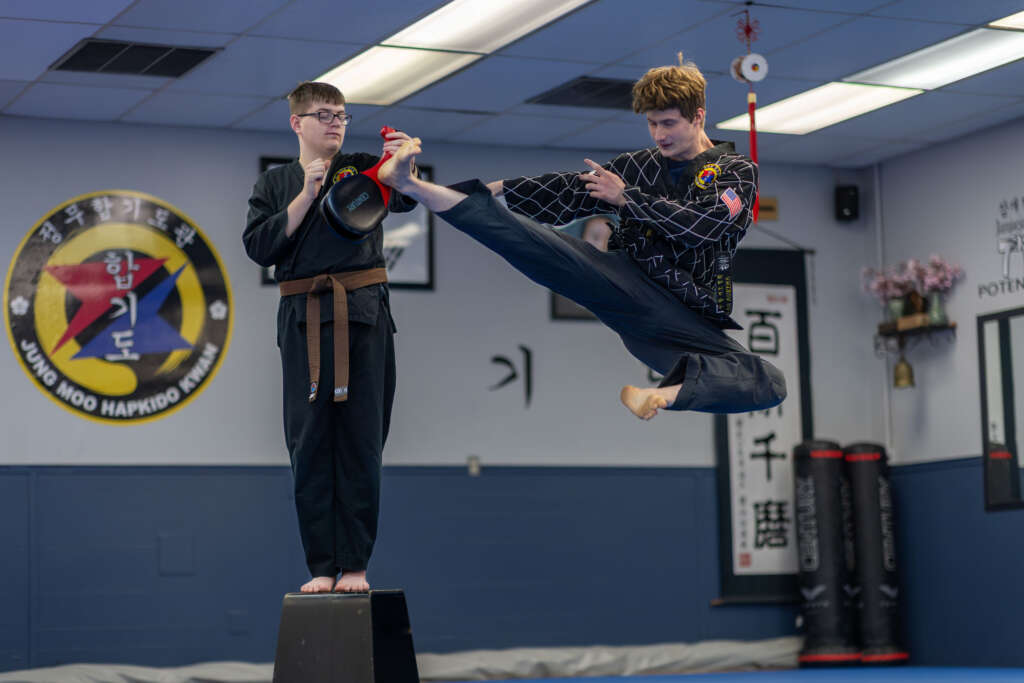
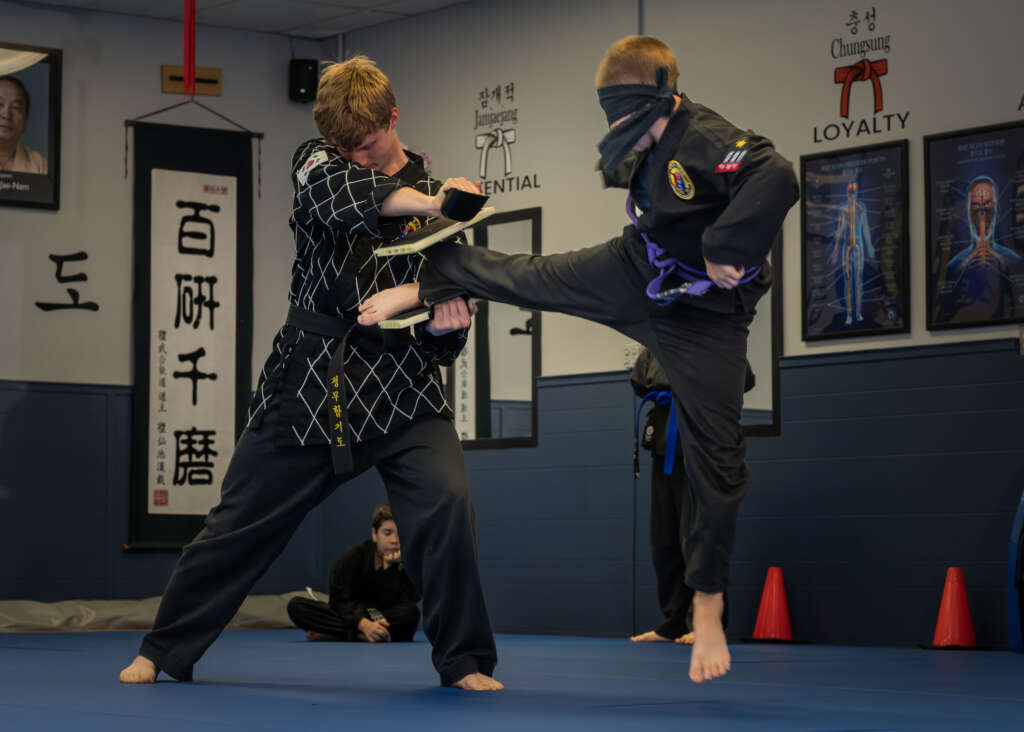
The way of coordinated power.

HAPKIDO

합  Hap — To coordinate / harmonize.

기  Ki — The energy of body and mind.

도  Do — The path, the daily practice of becoming.

What Separates HapKiDo

This is self-development. Not ego development.

What you develop here is not a competitive edge. It is something that belongs to you permanently.

What separates HapKiDo from a fitness class or a sport is that it trains the whole person.

At JMAFC, every class works across three dimensions simultaneously.

A Complete System: Three Dimensions of Training

01

PHYSIOLOGICAL

Strength of Body

The physical curriculum begins not with how to strike, but with why the strike works. Anatomy, physics, leverage, and structure taught as the science behind every technique.

02

PSYCHOLOGICAL

Focus of Mind

Real self-defense begins in the mind. Students study the brain, the stress response, and the chain from thought to emotion to action. The focused mind is a trained skill, not a gift.

03

PHILOSOPHICAL

Calmness of Spirit

The most important opponent a student will ever face is themselves. The philosophy of Musa Jungsin shapes every class: who you are becoming is the deeper work.
DIMENSION 01

Physiological —Strength of Body

In our curriculum we view HapKiDo as a science. The physical curriculum begins not with how to strike, but with why the strike works. Students learn the skeletal system, the nervous system, the circulatory system, and the muscular system not as background knowledge but as the operating manual for every technique they train.
A joint lock is not memorized as a movement. It is understood as the application of mechanical force to a joint operating at the limit of its designed range of motion. That understanding is the difference between a technique that works once and a technique that works every time when executed properly.
Physics is taught alongside anatomy. Leverage, center of gravity, momentum, and circular motion are not metaphors here. They are the principles that explain why a smaller practitioner, properly trained, can control a larger one. Angle, structure, and timing matter more than size and strength.
The physical curriculum covers strikes and kicks across three families of technique, joint locks, throws and takedowns, ground defense, weapons training, and defense against armed attackers. Each method is built on the same scientific foundation. When a student understands the foundation, the concepts and methods, they do not need to memorize hundreds of individual techniques. They understand the principles well enough to apply them in any situation, against any opponent, under any conditions.
That is the science at the heart of this martial art.
Dimension 02

Psychological — Focus of Mind

Real self-defense begins before the first technique is thrown. It begins in the mind, and so that is where the study begins.
HapKiDo students study the brain alongside the body. The stress response is something students experience in training and study outside of it. Cortisol, adrenaline, the physiological chain that follows a perceived threat. These are examined as the predictable, understood processes they are, not mysterious forces that happen to you.
The study goes deeper than chemistry. Students learn how thoughts lead to emotions, how emotions lead to actions, and how actions direct outcomes. That chain is not abstract philosophy. It is the architecture of every conflict, every confrontation, and every moment of pressure a person will ever face. Understanding it means being able to intervene in it, to catch a thought before it becomes a reaction, to recognize the stress response as it arrives rather than after it has already made the decision for you.
Meditation and focused breathing practices are part of this curriculum for exactly that reason. They are not supplementary. They are the training ground where the focused mind is developed, where the ability to remain present under pressure is built through repetition the same way a technique is built through repetition.
The focused mind is not a gift. It is a skill. And like every skill in HapKiDo, it is taught, it is trained, and it is earned.

Philosophical — Calmness of Spirit

The martial arts tradition that produced HapKiDo understood something that sport culture rarely touches: the most important opponent a student will ever face is themselves.
Calmness of spirit is not passivity. It is not simply knowing when to walk away. It is the ongoing, sometimes uncomfortable process of discovering who you actually are, what you are made of when things are hard, what you default to under pressure, what you are capable of that you did not know before you started training.
The philosophy of Musa Jungsin, the warrior spirit, shapes every class at this school. It is the standard that shows up in how students carry themselves, how they treat the people around them, and how they respond when training demands something they do not yet have.
A student who trains here long enough stops asking what they are learning and starts asking who they are becoming. That question, pursued honestly over years of practice, is the heart of what HapKiDo offers. The techniques are real. The self-defense is effective. But the student who earns a black belt here has gained something that cannot be measured in technique. They have found a version of themselves they did not know existed when they walked through the door.
Not the absence of fire. The presence of a person who knows exactly who they are and does not need to prove it to anyone.
Built for Real Conditions

Self-Defense. Not a Sport.

HapKiDo is taught to law enforcement officers, military units, and special operations personnel around the world. The reason is straightforward: it works under real conditions, against real threats, including multiple attackers and armed opponents.
Sport martial arts are designed for the mat. Rules protect competitors. Referees stop the action. Points are awarded for controlled techniques. None of that exists on the street. HapKiDo is built for the world as it actually is, with no assumptions about who is attacking, how many there are, or what they are carrying.
The techniques range from non-lethal control, joint locks and restraints used by law enforcement, to decisive force when the situation demands it. Students learn both, and more importantly, they learn the judgment to know the difference.

CURRICULUM

What You Will Train

The Musa Jungsin HapKiDo curriculum at JMAFC covers eight methods of practice, each building on the others.

01 Son Bal Gongbang Beop

Hand and Foot Methods

02 Gwanjeolki Beop

Joint Locking Methods

03 Uibok Beop

Clothing Grab Defenses.

04 Bangtuki Beop

Holds and Body Grab Defenses.

05 Badag Beop

Ground and Seated Defense Methods.

06 Nok Beop

Safe Falling Methods

07 Seon Beop

Offensive / Initiative Methods.

08 Muki Beop

Weapons Use and Defense Methods:  Knife, Stick, Cane, Staff, and Improvised Tools.

Advanced students also train in Korean sword and, at the black belt level, firearms skill sets.

32 Years on the Mat

Founded in 1994

The Instruction

32 Years. Still Here.

At Jung Martial Arts Family Center (JMAFC), we preserve and teach HapKiDo as it was intended, with authentic technique, cultural tradition, and a clear philosophical foundation. We are not a martial sport club or a neighborhood gym, and Musa Jungsin HapKiDo is not demonstration-style martial arts. We are an accredited Korean martial arts educational center. We do not teach fighting. We do not inflate ego. We develop the whole person – Strength of Body, Focus of Mind, Calmness of Spirit, not as a tagline, but as the actual work of every class. That is why we have been a working school in this community for 32 years.

We teach children, teenagers, and adults. We teach beginners and experienced practitioners.
Who Trains Here

Who is HapKiDo for

ADULTS
Ready to train seriously. Looking for something real, not a trophy. Committed to the long work of self-development.
CHILDREN & TEENAGERS
Ready to be challenged and discover what they are made of. This is a practice that asks for commitment and returns something that lasts long after they leave the mat.
HapKiDo at JMAFC is for people who want something real. This is a practice that asks for commitment and returns something that lasts long after you leave the mat.

How committed are you?

Take the First Step

The best way to understand what HapKiDo at JMAFC is about is to experience a class. We offer a free trial lesson with no obligation and no pressure. Come in, train with us, and decide for yourself.

Book Warrior’s Portrait

[ssa_booking type=warrior-portraits-single]

Stay Connected!

Join JMA Alerts

Events, Closures, Schedule Changes, News and more…fast.

Choose text, email, or both.

 Unsubscribe anytime.

[uws_form type='subscribe' group_id='1' name='no']

Headline

Never Miss A Story

Get our Weekly recap with the latest news, articles and resources.
Cookie policy
We use our own and third party cookies to allow us to understand how the site is used and to support our marketing campaigns.